Workflow mistakes in organizations, and how a management system solves them
When the system does not grow with the business, that is usually where the problems begin
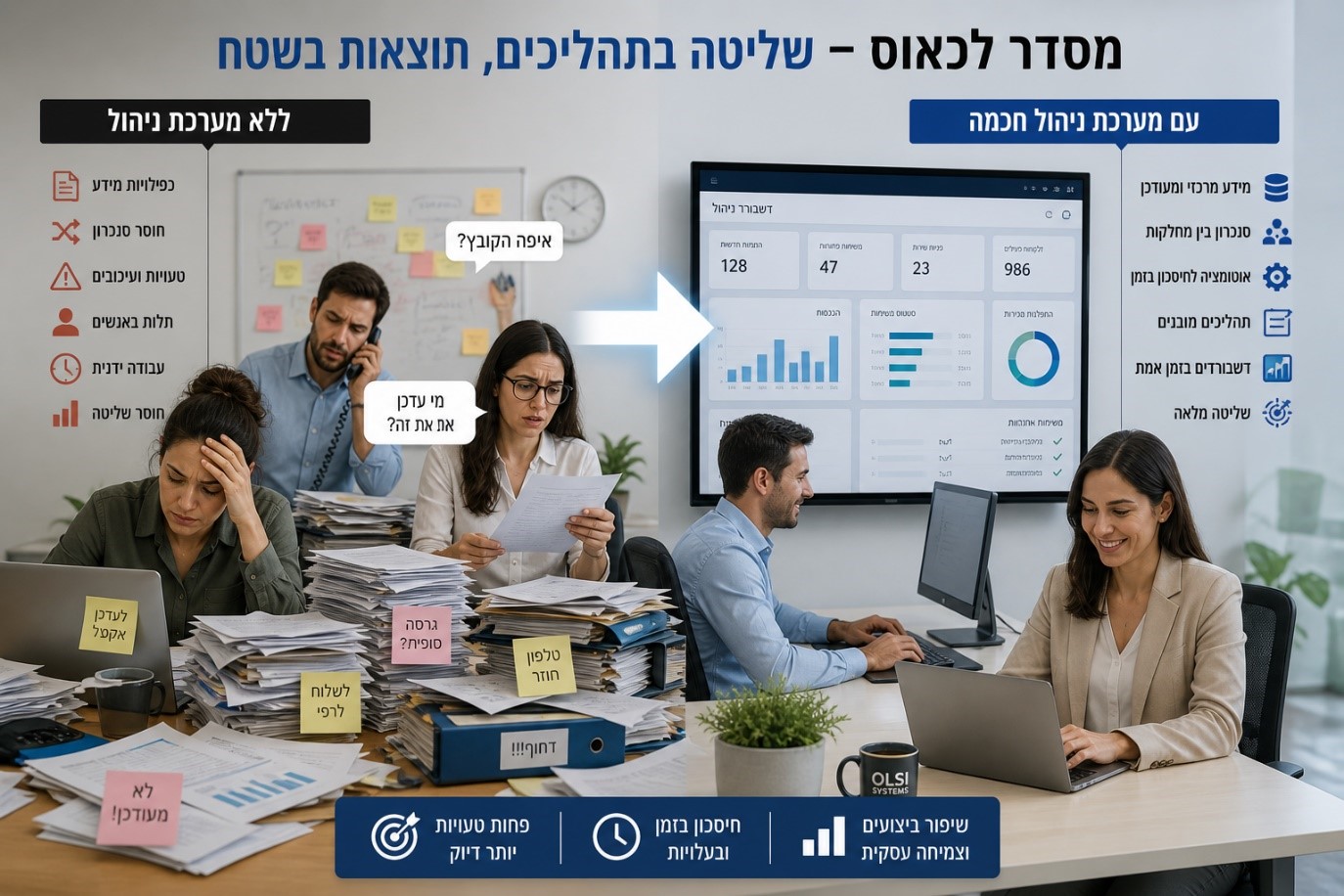
In most organizations, workflows are not planned in advance - they evolve over time.
At first it works: Excel, emails, maybe an old system.
But as the business grows, those tools can no longer handle the load.
The result is disorder, mistakes, delays, and above all a direct hit to profitability.
This is the point where you realize the problem is not with the employees, but with the management infrastructure of the business.
Duplicate data, the first sign of a systemic problem
When the same information is entered in several places, the organization loses control.
Customers appear in several files, orders are logged in both email and Excel, and updates fall through the cracks.
A smart management system centralizes all the data in one place.
Every piece of information is entered only once and updates in real time for all users.
Lack of sync between departments, a direct hit to service
In many organizations, each department works separately. Sales, operations, and service, each with its own tools.
The trouble starts when information needs to be handed off. Customers feel the delays, the mistakes, and the lack of coordination.
A custom management system connects all the departments into one continuous process.
Every stage in the process is updated in real time, and everyone in the organization sees the same picture.
Dependence on employees, a real operational risk
When knowledge lives in one employee's head, the organization is exposed. If that employee is unavailable, the process grinds to a halt.
A smart system defines processes in a structured way: stages, rules, and controls.
That way the knowledge is kept inside the system rather than depending on a single person.
Manual work instead of automation, waste that adds up to money
Repetitive tasks - such as sending emails, updating statuses, or producing documents - eat up valuable time.
When they are done manually, they are also prone to mistakes.
An advanced management system built by OLSI Systems – a boutique software house, enables full automation of recurring processes. Your employees are simply freed up for higher-value work, and the organization runs faster and with greater accuracy.
This is how you make decisions based on data, not gut feeling.
What does a custom management system at OLSI Systems look like?
A smart system does not start from the code, but from a deep understanding of the business. It is built around the existing processes, the real-world problems, and the future goals.
The system connects departments, centralizes information, and creates a workflow that is consistent, clear, and efficient.
That is the difference between "just another piece of software" and a tool that creates a real competitive advantage.
In summary,
Improving processes starts with the right decision!
Organizations that keep working with the wrong tools pay for it in time, money, and missed opportunities.
Organizations that invest in a custom management system, on the other hand, enjoy control, efficiency, and growth.
Our company, OLSI Systems, specializes in custom software development for businesses, with an emphasis on improving organizational processes and smart automation.
The goal is to build a system that works for the business, and not the other way around.
OLSI Systems is here to build the precise solution for you,
one that fits you today and grows alongside you tomorrow.
Leave your details for a callback or give us a call 09-8820511
Frequently asked questions
How do you know there is a problem with your organization's workflows?
When there are duplicate data, recurring mistakes, delays in handling customers, or dependence on specific employees, these are clear signs that the processes are not being managed properly.
What is the advantage of a custom management system over off-the-shelf software?
A custom system is built to fit the business exactly, including its unique processes, integrations, and automations. Off-the-shelf software, by contrast, forces the business to adapt itself to the system.
Is a smart system only right for large organizations?
No. Small and mid-sized businesses can also gain a great deal from a custom system, especially when there is a heavy workload, many customers, or complex processes.
How long does it take to roll out a management system in an organization?
The timeline varies with the complexity of the project, but in most cases it is a process of several weeks to several months, including specification, development, and rollout.
Can a management system be integrated with existing systems?
Yes. Advanced systems can connect to existing systems such as CRM, accounting, inventory systems, and more, creating a unified work environment.