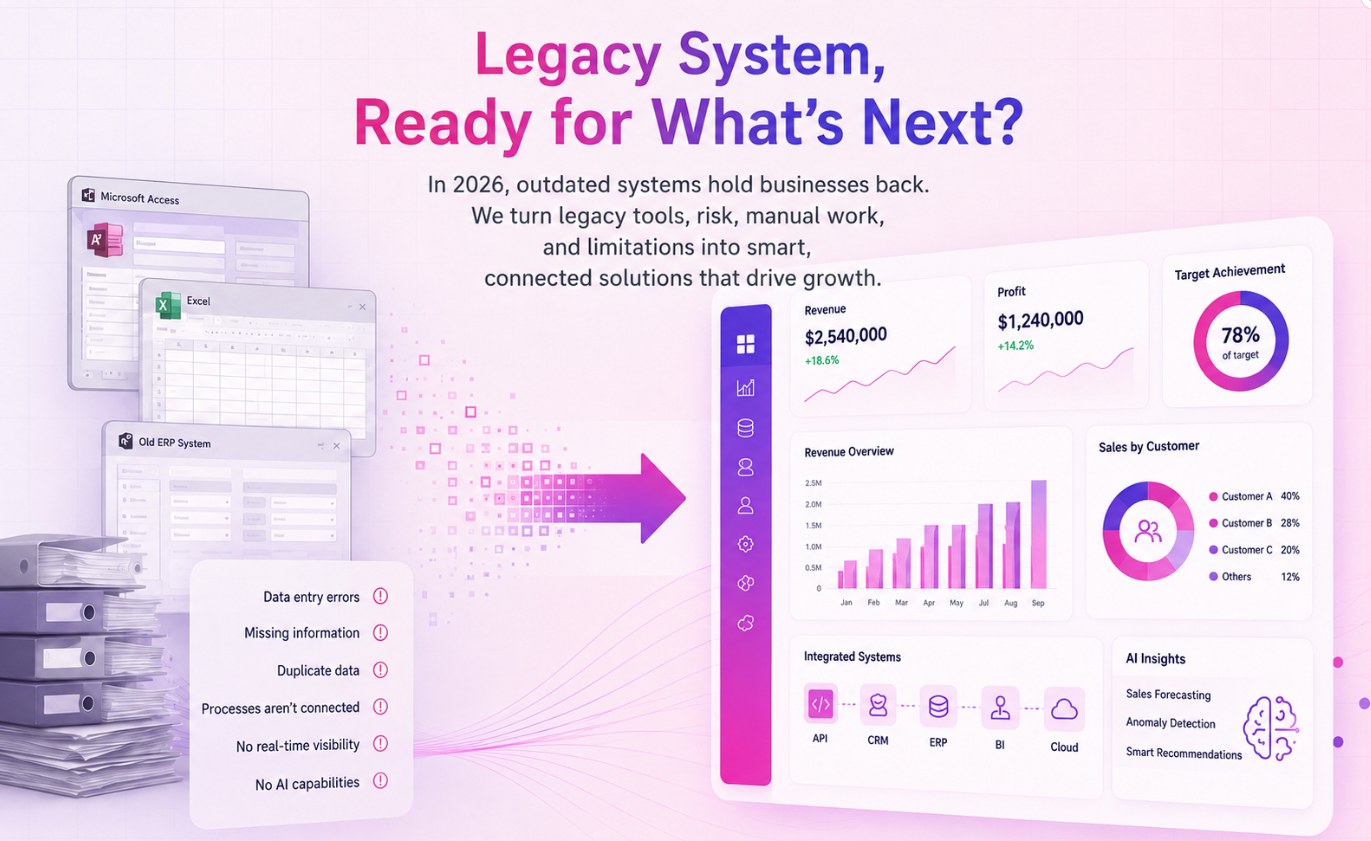
Many business owners tell themselves: "The system works, so why change it?"
It's a natural thought. After all, no one wants to invest time and money in something that looks stable.
But the business reality of 2026 is completely different from that of a decade ago. Legacy systems don't just stay "outdated" - they gradually become a factor that slows the business down, increases information security risks, makes regulatory compliance harder, and prevents the adoption of new technologies.
Whether your business runs on an aging Access system, Excel files that have turned into a management system, an old ERP, or some other software developed many years ago, it's worth pausing for a moment to examine whether it still serves the business - or actually holds it back.
1. The Knowledge Lives With Only One Person
This is one of the most common situations in organizations.
There is one employee, an external developer, or a systems person who knows all of the system's "secrets": which tables are linked to one another, which macros drive which processes, and how to fix a problem without causing damage.
As long as that person is available, everything looks fine.
But what happens if they leave the company, retire, go on an extended leave, or are simply unavailable?
In an instant, the system becomes a "black box" that no one dares to touch. Every small change turns into a complex task, and every glitch can bring an entire business process to a standstill.
A system that is critical to the business should not depend on a single person.
2. The System No Longer Receives Security Updates
At some point, older technologies stop receiving support and security updates from the vendor.
When new vulnerabilities are discovered, they go unpatched, and the business's exposure only keeps growing.
As the years go by, more and more known security holes accumulate, while the system stays exactly as it was.
If your system holds information about customers, suppliers, orders, or financial data, this is no longer just a technological problem - it is a significant business risk.
3. Regulation Changes, and the System Falls Behind
The business world is changing fast.
Government authorities, tax agencies, and international bodies regularly update regulations, requirements, and reporting obligations.
A system built ten or fifteen years ago was not designed to handle today's requirements.
A good example is the electronic invoicing reform in Israel, which took effect in 2026 and requires adjustments across many systems. The changes are significant, and older solutions are gradually losing their official support.
So the question is no longer whether the system still works, but whether it can keep supporting the demands of the business and regulation in the years ahead as well.
4. A Single Failure Can Halt Business Operations
Many businesses still run on a local system installed on a single computer or on an aging server.
In many cases there is no automatic backup, no data replication, and no orderly recovery plan.
It only takes a corrupted Access file, a crashed hard drive, or a damaged central Excel file for the business to find itself without critical information.
A modern system generally enables automatic backups, cloud-based work, and fast recovery in the event of a failure, so that even an unexpected incident does not shut down operations.
Learn more about upgrading an Access system to a smart web system
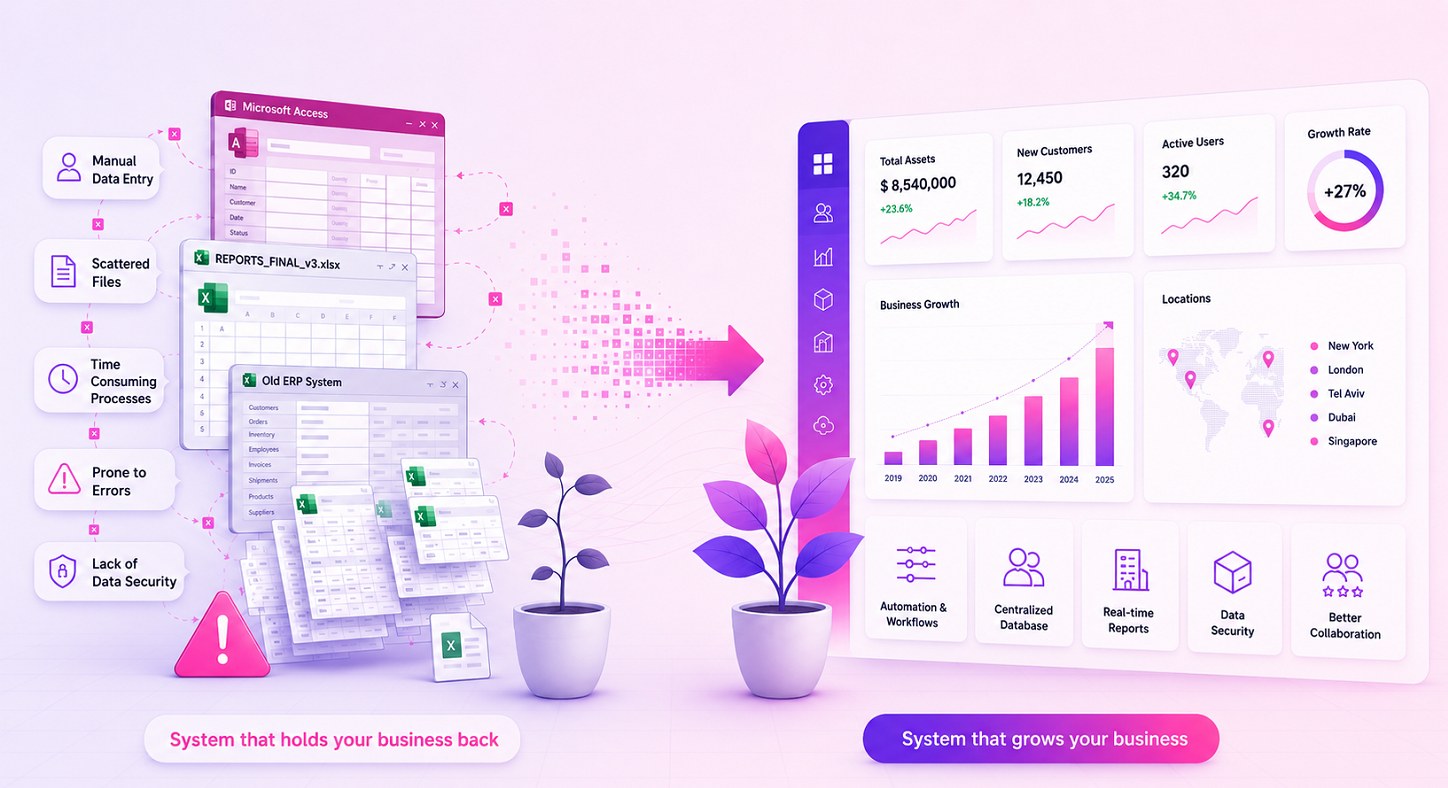
5. The Business Grows, but the System Does Not Grow With It
What suited a small business ten years ago does not necessarily fit the business of today.
More employees, new branches, more customers, or new services all require a flexible system that can grow together with the organization.
When every small change requires manual adjustments, file duplication, or cumbersome processes, the system stops being a working tool and becomes a bottleneck.
In many cases, it is the management system itself that limits the pace of the business's growth.
6. It Is Harder to Find Professionals Who Know the Technology
Many systems are still based on legacy technologies such as Access, VB6, COBOL, or PowerBuilder.
Over the years, the number of developers who know these technologies in depth keeps shrinking.
The implications are clear:
- It is harder to find a suitable professional.
- Turnaround times get longer.
- Maintenance costs rise.
- Every small change turns into a complex project.
The longer you wait, the more challenging and expensive the upgrade process becomes.
7. You Cannot Leverage AI and Innovation When Your Data Is "Locked In"
More and more businesses want to incorporate artificial intelligence tools to streamline processes, analyze information, generate business forecasts, and turn manual tasks into automated ones.
But there is one problem that comes up again and again.
When data is scattered across Excel files, stored in an old Access system, or held in a system that offers no interfaces (API), it is nearly impossible to connect new tools to it.
Before bringing AI into the business, you need to make sure the technological infrastructure lets you work with the data in an organized, secure, and accessible way.
A modern system does not just improve day-to-day work - it also lets the organization benefit from the innovation tools of the years to come.
So, Is It Time to Upgrade?
Not every legacy system has to be replaced immediately, and not every business needs to launch a massive project.
But if you have recognized two or three of the signs described here, it is worth at least carrying out a professional assessment of your current situation.
Sometimes a gradual upgrade is possible, and sometimes it is better to develop a new system tailored to today's business needs - all while preserving the existing data and processes.
The goal, in fact, is not to replace a system just because it is old, but to make sure it keeps serving the business in the years ahead.
OLSI Systems: Guiding Businesses Through the Move to Advanced Systems
For more than 30 years, our company, OLSI Systems - a boutique software house, has been helping organizations and businesses upgrade their information systems, convert Access and Excel systems into advanced web solutions, develop custom software, and build technological infrastructures that let a business grow with confidence.
We believe that every project begins with understanding the business needs, not with choosing the technology. That is why, before deciding whether to upgrade, convert, or develop a new system, it is important to run a professional diagnosis of the existing system, identify its strengths and weaknesses, and build a work plan that fits the business and its goals.
If you are not sure whether your system still serves the business or holds it back, we would be glad to review your current situation together and suggest the right, safe way forward.
Get in touch by leaving your details for a callback, give us a call, or reach us on WhatsApp
We would be glad to help!