What a Workday Looks Like at a Business Running on a Smart System: Before and After
A Real Example From the Curtains Industry
There is a stage in every business's growth where the challenge is no longer bringing in customers, but running the operation efficiently and accurately. The work is there, the orders keep coming, but behind the scenes the pressure starts to build up: measurements, coordination, catalogs, quotes, payments. In the curtains industry, where every project is different and every small detail can affect the final result, this challenge is felt especially sharply.
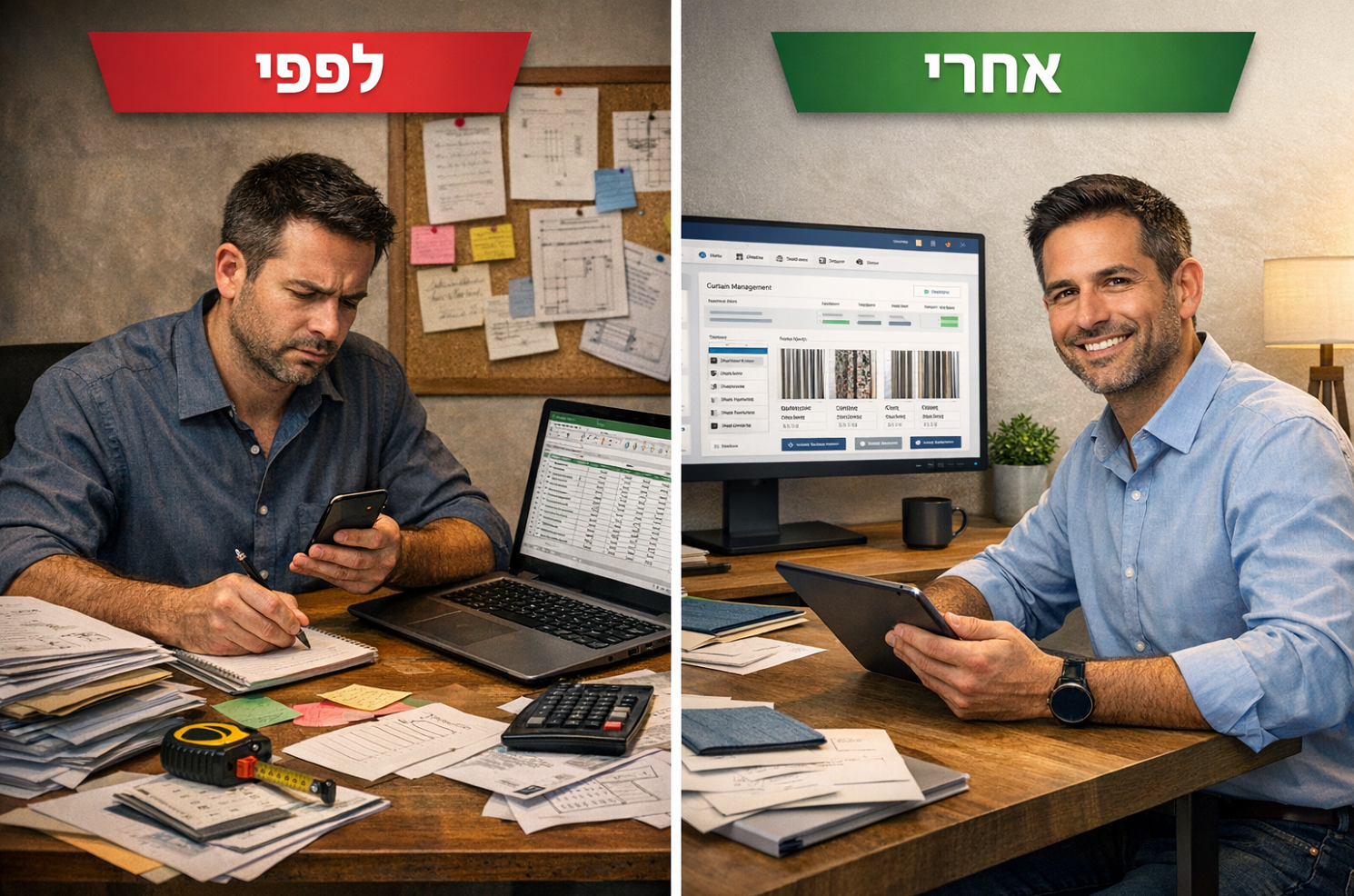
To understand the real impact of a smart system, it is worth pausing for a moment to look at a typical workday, before and after.
Before: A Lot of Work, Little Control
The workday begins at the customer's place, with the measuring. The measurer shows up with a sheet of paper or a phone, jots down dimensions, takes photos, adds a few notes to themselves. Some of the information is kept in their head, some in WhatsApp, some in a notebook. Already at this stage, the process becomes dependent on the memory and personal order of each employee - and that is exactly where the mistakes begin.
Back at the office, the stage of "translating" all this information into something you can actually work with begins. Someone has to take the measurements, enter them into Excel, check curtain types, match fabrics, recalculate dimensions. This is a process that repeats over and over, and sometimes involves double entry, corrections, and gap-filling.
The quoting stage is far from simple too. The calculation is done manually or semi-manually, moving between files, checking prices, and making adjustments. Any small mistake can affect profitability, or your credibility with the customer.
The Sales Stage
At the sales stage, the picture does not always get better. The customer wants to see options, understand the differences, choose colors and styles. In practice, the reps rely on catalogs, photos, or partial information that is sometimes out of date. The experience is less professional than the business would like to present.
The challenge continues out in the field as well. Installers arrive at customers with information that is not always complete or accurate. Uncertainty about dimensions, types, or special notes leads to delays, mistakes, and sometimes even repeat visits. Every such mistake translates directly into cost - in time, in money, and in customer satisfaction.
Payment management creates its own strain. Tracking who paid, how much is still outstanding, and which projects are closed - all of this is handled through a mix of files, messages, and notes. The result is a lack of full financial control.
After: The Same Business, a Completely Different Way of Working
When a smart system built to fit the business comes into the picture, the workday looks completely different - not because the business changed, but because the way information flows and is managed changed.
The measuring stage becomes digital and precise. The measurer enters all the data directly into the system, including dimensions, curtain types, notes, and photos. There is no need to remember, no need to move information between different systems, and everything is kept in one place, organized and accessible.
At the office, there is no more re-entering data or duplicate work. All the information already lives in the system, available to the team, and can be acted on immediately. This saves valuable time and significantly reduces mistakes.
Quotes change fundamentally too. Instead of manual calculations, the system produces an accurate quote at the click of a button, taking the project's various parameters into account. The result is a combination of speed, accuracy, and professionalism in front of the customer.
At the sales stage, the team works with a single tool that brings together all the options - fabric types, colors, designs, and customizations. The customer gets a clearer picture, and their ability to make a decision improves. It is not just more convenient - it also raises close rates.
Out in the field, the change is significant too. Installers arrive with all the information they need: exact dimensions, curtain type, installation location, and special notes. There is no room for guesswork or interpretation. The work becomes more accurate, faster, and makes it possible to complete more installations in a single workday.
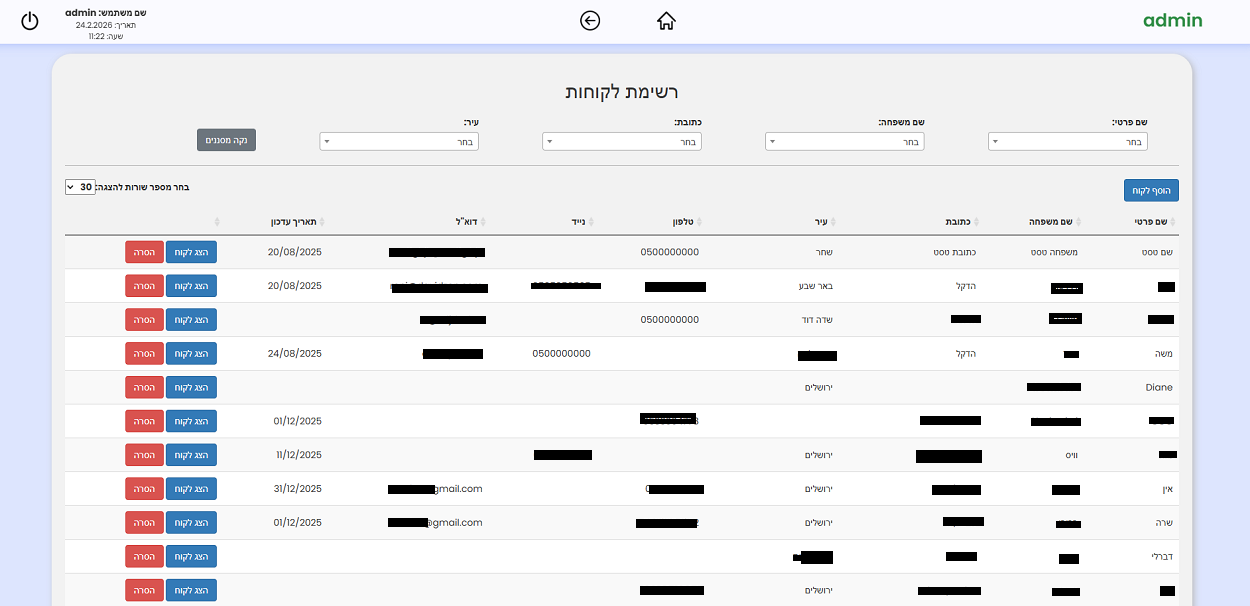
At the same time, payment management becomes transparent and organized. All customer details, orders, and collections live in one place. At any given moment you can see what has been paid and what is still outstanding, and manage the financial side of the business far more accurately.

What Really Changed?
The change is not only technological. This is a deep change in the way the business runs day to day. The shift is from work based on memory, scattered files, and manual processes to work based on data, order, and control.
Instead of chasing after information, the information is available and accessible. Instead of fixing mistakes, you prevent them in advance. Instead of wasting time on repetitive tasks, you focus on the actions that create real value for the business.
For each client, we at OLSI Systems tailor unique development to fit the needs of the business. For example, for a business in the curtains field, we developed - at the client's request - the ability to track the status of every single curtain within an order: whether it has been sent to production, and if so, where; whether it has come back from production and arrived at the warehouse, and so on. In other words, the software was developed and tailored exactly to the dimensions of our client's business.
Far Beyond the Curtains Industry
This example comes from the curtains industry, but the principle applies to almost any business with complex processes: factories, stores that offer customization, service companies, and organizations with many stages in their workflow.
The approach of OLSI Systems is not "to fit the business to the software," but to develop a system that fits exactly the way the business works, and where it wants to go.
In Summary,
When all your processes are run from a single system, something fundamental changes. The work becomes more accurate, faster, and more profitable. Management gains control, employees work more efficiently, and customers feel the difference.
A smart system is not just a piece of technology: it is the infrastructure that lets a business grow in an orderly, stable, and sound way.
Do you also want to upgrade and streamline your plant or business?
Leave your details and we will get back to you or call us at 09-8820511