
End of the year, the warehouse closed, two employees walking shelf by shelf and counting. By the end of the day there is a number. Then someone opens the spreadsheet that has been running inventory for the past four years, and a different number is written there. Not close. Different. Now somebody has to decide which of the two goes into the report, and which one gets called a mistake.
That is the moment most businesses discover they never managed inventory. They recorded it.
The gap is not created by the count, it is only revealed by it
An annual count is not a measurement of the warehouse. It is a measurement of every record made over the course of the year, all in one go. When it does not add up, the problem is not the employees who counted yesterday but one of the 365 times something came in or went out and nobody documented it properly.
The trouble is that a count returns a single number. It tells you a gap exists, and it does not tell you where the gap came from. There is no route back from it to the event that created it.
A system that manages inventory properly does exactly the opposite. It does not hold a number, it holds a chain of movements that the number is derived from. When something does not add up, you can run backwards to the movement where the gap entered.
What the law actually requires you to manage
There is a point here that many businesses discover late. The regulatory requirement does not talk about "inventory" as a number at the end of the year. It talks about movement.
Israel's Income Tax Instructions on bookkeeping state that the inventory movement ledger must record the quantity of goods at the start of the year, every entry of goods into the business, every exit of goods from the business, adjustment entries with an explanation given, and the quantity of goods at the end of the year. And every such record has to include the date, the reference to the document, the unit by which the quantity is measured, and the quantity.
Read the words "adjustment entries with an explanation given" again. The law assumes in advance that there will be adjustments, and it does not prohibit them. It requires that each one carry an explanation attached to it.
That is precisely what a spreadsheet cannot do. In a spreadsheet, an adjustment looks like someone clicking into a cell and changing 470 to 412. There is no date, no reference, no reason, and no way to know it happened at all.
As for the count itself, the instructions allow some flexibility: stock may be taken on the balance sheet date, or within a month before or after it, provided there are records that make it possible to reconcile the result back to the closing date of the year. That flexibility is worth something only if movement tracking exists and can be rolled forwards and backwards. Without it, any count date other than December 31 is a guess.
The three places where the quantity changes and nobody records it
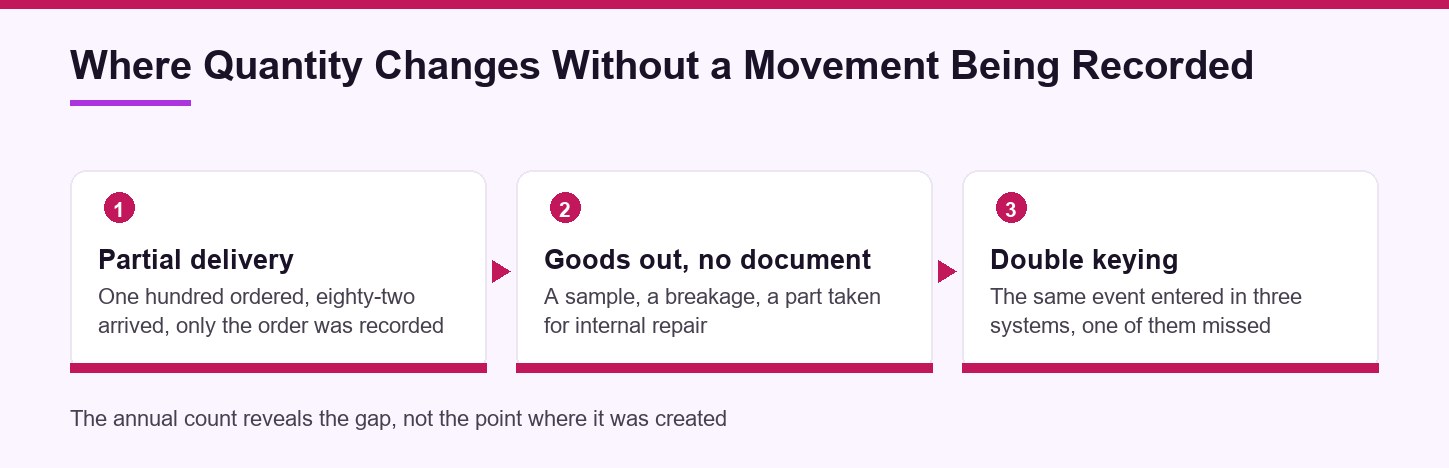
In practice, the gap is almost always born in one of three places:
- Partial receipt of a delivery. A hundred units were ordered, eighty-two arrived, and the system recorded the order rather than the delivery. Eighteen units that do not exist go on living in the books.
- A product that leaves with no document. A sample for a customer, an item that broke, a part taken for an internal repair, a return that made it back onto the shelf but not into the records. All of these are real movements of goods out of the business with no paper behind them.
- Double keying between two systems. The order is recorded in the sales system, the warehouse updates a spreadsheet, and bookkeeping types it into a third. Three records of the same event, and it only takes one of them to be missed.
The third is the most dangerous of them, because it does not look like a mistake. It looks like work. Someone sits and types the same figure a second time, and on most days they type it correctly.
Until they do not. The answer to that layer is not to type better but system integration, so that the event is recorded once and flows from there to everyone who needs it.
Why a spreadsheet stops holding up exactly as the business grows
A spreadsheet works beautifully at one stage: one person, one warehouse, a few dozen items. It stops working not when the business reaches a certain size, but when the second person joins it.
From the moment there are two, three capabilities are needed that a spreadsheet does not provide: knowing who changed what, keeping two people from overwriting each other, and holding a history you can go back to. A spreadsheet gives you a current snapshot. It does not give you the path that led to it.
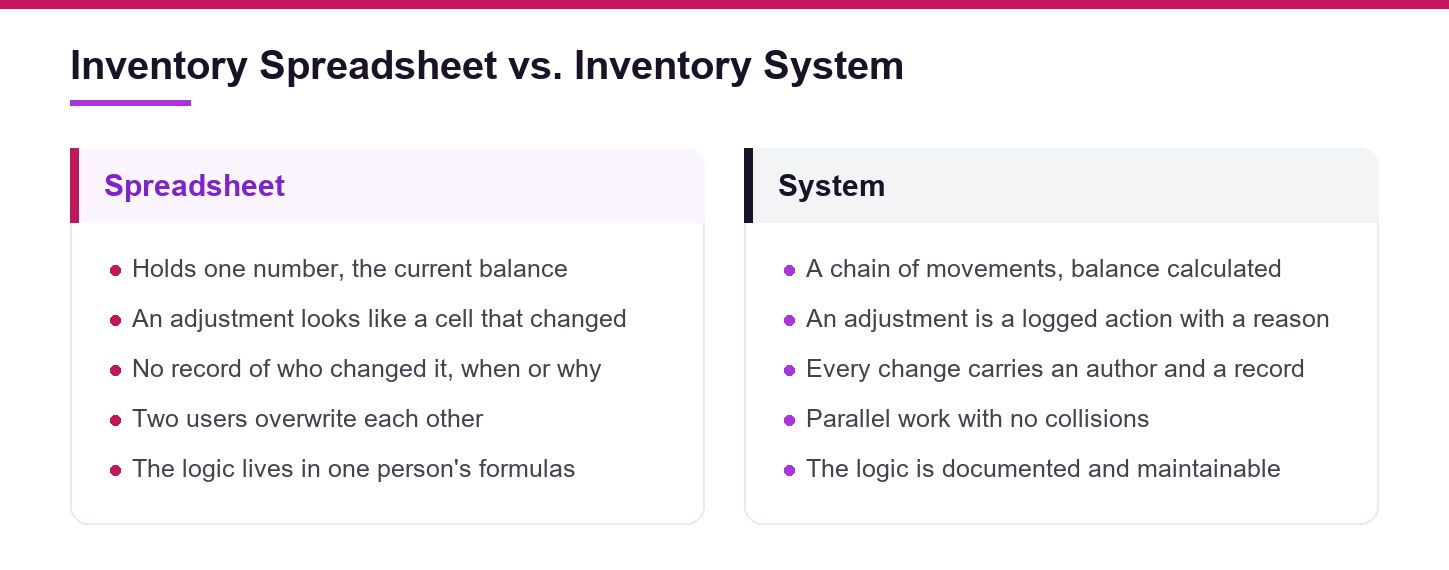
There is also a risk here that is hard to see from the inside. The more sophisticated the spreadsheet becomes, the more of the business's logic sits in formulas that one person built and only that person understands. This is no longer a tool, it is a system with no documentation. An Excel upgrade to a real system is first and foremost about getting that logic out of the cells and into somewhere that can be maintained.
What a system the count agrees with looks like
It does not have to be a large system. It has to hold four things:
- Every movement as an independent record. Goods in, goods out, returns, shrinkage and adjustments, each one with a date, a source document, a unit of measure and a quantity. The balance is always calculated from the movements, and never typed in by hand.
- An adjustment that is a documented action. Who carried it out, when, what the quantity was before and after, and what the reason was. An adjustment with no reason is simply not saved.
- A single point of entry. The event is recorded where it happens, and spreads out from there. Not three keyings of the same thing.
- Counting as a process rather than an event. The ability to count a group of items at any moment, compare it against the calculated balance, and close the gap as a documented adjustment. A business that counts a small group every week does not reach the end of the year with a surprise.
We build an inventory management system around the way goods actually move in your business, rather than around a generic template. At a manufacturer it looks different than it does at an importer, and for a business running one warehouse it looks different than for one running three. The structure follows the process you already have, instead of forcing a foreign template onto it that your staff will end up working around.
Frequently asked questions
Can we keep working with the spreadsheet alongside a new system?
You can, and during the transition that is usually the right thing to do. The spreadsheet goes on serving analysis and forecasting, and the system holds the movements. What matters is that only one of them is the source of truth for quantity, otherwise you have created two versions of the same inventory.
How long does it take to move existing inventory into a system?
That depends on the scope and on the state of the existing data, and we do not leave it vague. The estimate is built after we have seen the spreadsheet and the way the warehouse works. In most cases the migration is done in stages, so the business keeps operating throughout the process.
What do we do about the gap that came up in the last count?
You record it as an adjustment with an explanation, and start tracking movements from that point onwards. There is no way to reconstruct a year that was never documented, but you can make sure the next one closes without that same conversation.
Does an inventory system need to connect to the accounting software?
In most cases yes, and it is the connection that pays for itself the fastest. It removes the double keying where a large share of the gaps are born, and it lets the accountant receive a figure derived from movements instead of a number that was typed in by hand.
The gap between the warehouse and the report is almost never a counting problem. It is the sign that quantity is being managed as a number instead of as a chain of events. Once every entry, exit and adjustment is documented in one place, the annual count stops being a test and starts being a confirmation.
The question is no longer whether you know how much you have. The question is whether you know where that number came from.
For a solution tailored to your business:
Get in touch by leaving your details for a callback, give us a call, or reach us on WhatsApp
We would be glad to help!