
How much does the software you work with cost you? Most business owners can answer that fairly quickly: licence fees, maintenance, technical support or a monthly payment to a vendor. But what about the money the business loses precisely because of how the software is used?
An employee who wastes fifteen minutes every day on an unnecessary task, a manager who waits for a report instead of getting data at the click of a button, or an order that is delayed because of a manual process. All of these look like part of the daily routine, but cumulatively they can cost the business thousands of shekels a month.
Before investing in a new system, it's worth understanding how much it costs the business to keep working with the existing one, and how to identify the expenses that don't appear on any invoice.
The real cost of software is more than the price you pay for it
When a business examines its technology expenses, it usually looks at the direct costs: purchasing software, user licences, cloud services and maintenance.
But software also affects how long tasks take, how many employees are involved in a process, and the business's ability to provide fast service.
For example, a system that costs 500 shekels a month may look economical. But if using it requires employees to spend dozens of extra hours each month, its operational cost may be far higher.
So before deciding whether to keep using a particular piece of software, it's important to consider not only how much you pay for it, but also how many resources are needed to work with it.
How much does a repetitive manual task really cost?
Let's take a simple example from a business where five employees are required to perform a manual task that takes 20 minutes every day. This could be transferring data, checking details, producing a document or updating a status in the system.
At first glance, 20 minutes doesn't sound like a significant problem. But the cumulative calculation tells a different story:
- Five employees perform the task every day.
- Each employee spends 20 minutes on it.
- There are 20 working days in a month.
- In total, this adds up to around 33 work hours a month.
If the cost of an hour of work to the employer is 100 shekels, that means an expense of around 3,300 shekels a month, or about 40,000 shekels a year. And that's just one task.
Of course, this is an illustrative example and not a guaranteed saving. But it shows how small, repetitive actions can turn into a significant expense.
And what about the cost of errors and corrections?
Working time isn't the only cost. When employees have to key in data over and over, perform manual calculations or transfer information between different parties, the risk of errors grows too.
An error in an order may require handling it again with the customer. An incorrect figure in a report may lead to an additional review, and a detail that wasn't updated in time may cause a delay later in the process.
To assess the cost, it's worth checking how many recurring faults occur each month, how much time is spent handling each one and whether they lead to additional expenses.
Business software solutions can help reduce some of these errors through automated checks, orderly data transfer and clearly defined processes. That said, it's important to remember that a new system also requires testing, maintenance and proper implementation.
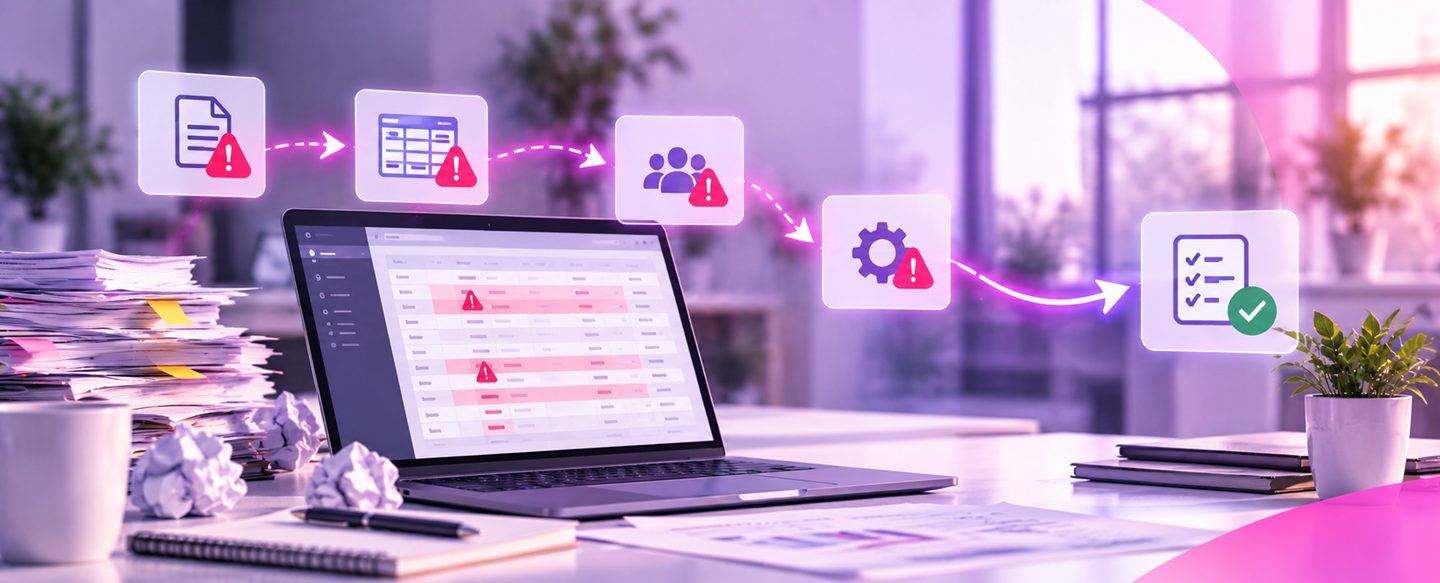
The time managers spend searching for information
Not every hidden cost is related to the work of operations teams. Sometimes it's actually the managers who spend a great deal of time trying to understand what's happening in the business.
How many orders are still open? Which tasks are delayed? What is the monthly volume of activity? Is the data shown in the report up to date?
When the information isn't readily available, each such question can lead to a round of checks, conversations and cross-referencing of data. Beyond the management time wasted, it can also slow down decision-making.
In suitable cases, software development can make it possible to present management information more accessibly, through dedicated reports or by connecting existing data sources.
Does inefficiency affect customers too?
Some costs are harder to measure in numbers. A customer who waits a long time for a reply, a quote that is delayed or an order that isn't handled on time don't necessarily create a direct expense you can see in the financial report.
All of these may affect customer satisfaction and the likelihood of them continuing to work with the business.
To understand the scale of the problem, you can check how much time passes from the moment an enquiry is received until it's resolved, how many times a customer has to provide the same details again, and how many repeat enquiries are created due to missing information.
Even when not every delay can be translated into a precise monetary amount, it's important to take it into account.
How do you check whether it's worth investing in improving the software?
Once you've identified the hidden costs, the next question is whether investing in improving the system is economically worthwhile. The calculation should also include the investment in development, the implementation time, the training and future maintenance costs.
For example, if a technological solution is expected to save the business 3,000 shekels a month and the cost of setting it up is 30,000 shekels, the theoretical payback period is ten months, before additional expenses. This isn't a forecast that fits every business, but a simple way to assess whether it's worthwhile.
A professional software house can help examine the technological feasibility of the change, but the decision should also be based on the expected business benefit.
Learn more about software development services.
OLSI Systems brings over 30 years of experience developing software solutions for businesses
Choosing a technological solution isn't just about writing code. It requires understanding the business processes, identifying the points where resources are wasted and choosing an approach that fits the organisation's needs.
OLSI Systems is a boutique software house operating since 1995, with over 30 years of experience in developing systems and software solutions for businesses, companies and organisations.
At OLSI, you work directly with the professionals who develop the system, without unnecessary layers of intermediaries. The support begins with understanding the business need and continues throughout development, implementation and ongoing support.
Do you suspect your current software is costing your business more than it seems? Talk to us, and together we'll review your workflows, identify opportunities for improvement and check which software solutions could save you time and money.
We would be glad to help!